

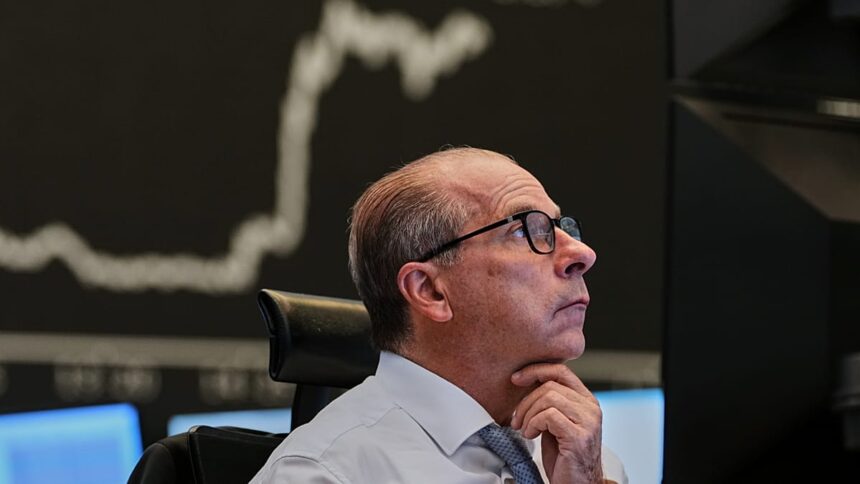
Global equity markets declined on Wednesday while oil prices surged after U.S. President Donald Trump indicated that the ceasefire between the United States and Iran had effectively come to an end, raising concerns over renewed military conflict and disruptions to energy supplies.
Speaking to reporters during the NATO summit in Ankara, Trump suggested that the memorandum of understanding with Iran was no longer in effect, adding to market uncertainty surrounding the geopolitical outlook in the Middle East.
The comments came after U.S. Central Command announced that American forces had conducted strikes against more than 80 targets across Iran overnight, including command-and-control infrastructure, coastal radar systems, anti-ship missile capabilities and vessels associated with the Islamic Revolutionary Guard Corps (IRGC).
Washington also revoked a waiver that had previously allowed Iran to restart oil exports, further intensifying concerns over global supply conditions.
Oil prices jump as geopolitical risks return
Brent crude, the international benchmark, rose more than 6% to $78.79 per barrel during European trading hours, while U.S. benchmark West Texas Intermediate climbed 6.3% to $74.88 per barrel.
Both benchmarks had recently retreated toward levels seen before the outbreak of conflict with Iran earlier this year, following expectations that tensions in the region would ease.
The latest escalation has renewed uncertainty over the direction of energy markets, particularly after oil prices had fallen significantly from peaks above $100 per barrel recorded during the conflict.
Technology stocks face additional pressure
Market sentiment was also affected by growing concerns that valuations across artificial intelligence-related companies have outpaced the earnings and productivity improvements expected from substantial investments in semiconductor manufacturing and data center infrastructure.
Ipek Ozkardeskaya of Swissquote said geopolitical developments were likely to remain the dominant driver of market sentiment in the short term, warning that a further deterioration in the situation could weigh on equity valuations and increase pressure on technology shares.
European and Asian equities retreat
European stock markets recorded broad declines, with Germany’s DAX index falling more than 2.2%, London’s FTSE 100 losing 1.5% and France’s CAC 40 retreating by more than 2% during morning trading.
U.S. stock futures also pointed lower, with major indices indicating losses of around 1% ahead of the opening bell.
In Asia, Japan’s Nikkei 225 dropped 2.1%, while South Korea’s Kospi index fell 5.4% as investors reduced exposure to technology shares and growth stocks.
South Korean semiconductor companies were among the session’s weakest performers, with Samsung Electronics declining 6.3% after a sharp sell-off in the previous session, while SK Hynix fell 5.7%.
Taiwan’s Taiex index managed to post gains of 0.6%, while Hong Kong’s Hang Seng Index advanced 3% amid strong performances from selected Chinese technology stocks.
Shares in Chinese artificial intelligence startup Zhipu, also known as Z.ai, rose nearly 14%, while the Shanghai Composite Index slipped 0.5%.
AI-driven sell-off continues on Wall Street
The volatility surrounding artificial intelligence stocks continued to weigh on U.S. markets. The S&P 500 declined 0.4%, despite gains in the majority of constituent companies.
The technology-heavy Nasdaq Composite dropped 1.2%, while the Dow Jones Industrial Average lost 0.2%.
Advanced Micro Devices fell 6.5%, Intel declined 9.7% and Micron Technology lost 4.7% as investors reassessed valuations across the semiconductor sector.
SpaceX shares fell 6.8% during their first trading session in the Nasdaq-100 index, while Rivian Automotive dropped 18.1% after announcing plans to issue 75 million new shares, increasing dilution concerns among investors.
Currencies remain relatively stable
In foreign exchange markets, the U.S. dollar strengthened slightly against the Japanese yen, trading at 162.26 yen compared with 162.11 yen previously. The euro edged higher against the dollar to $1.1426 from $1.1414.
Why it matters
The renewed escalation between the United States and Iran highlights the sensitivity of global markets to geopolitical risks, particularly in energy-producing regions. At the same time, concerns surrounding elevated artificial intelligence valuations continue to create volatility across technology stocks, increasing the likelihood that geopolitics and AI sentiment will remain the two dominant drivers of global market performance in the months ahead.