
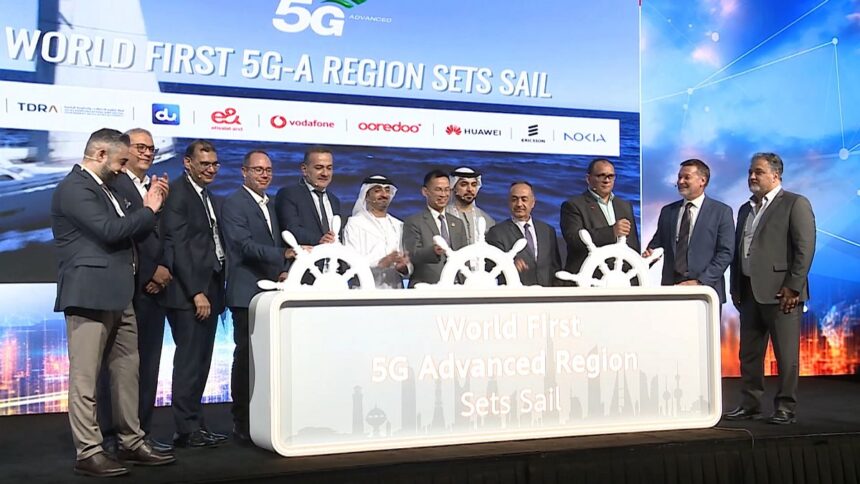
The Middle East is positioning itself as one of the world’s leading regions for the deployment of 5G-Advanced technologies, with telecommunications operators and policymakers accelerating investments in next-generation digital infrastructure.
During the Telecom Review Leaders’ Summit, industry executives from Oman, the United Arab Emirates and Qatar discussed how 5G-Advanced is beginning to reshape business operations and customer experiences across the region while creating new opportunities for enterprise innovation.
From faster connectivity to intelligent networks
Building on the foundations established by 5G networks, 5G-Advanced introduces improvements in speed, reliability, latency and network intelligence that are expected to support increasingly complex digital applications and services.
The technology is also designed to integrate more closely with artificial intelligence capabilities, enabling networks to optimize performance dynamically and respond more effectively to changing user demands and traffic patterns.
Supporting the next generation of smart cities
As smart city initiatives continue to expand globally, 5G-Advanced is expected to play a central role in supporting connected infrastructure and digital public services.
Potential applications include immersive virtual reality experiences, autonomous transportation systems, intelligent energy grids and industrial automation environments that require high-capacity and low-latency communications networks.
For governments and businesses across the Gulf region, these capabilities are increasingly viewed as strategic enablers of economic diversification and digital transformation agendas.
AI and connectivity converge
The convergence of artificial intelligence and advanced telecommunications infrastructure is expected to redefine how industries operate, creating opportunities for predictive maintenance, automated operations and real-time analytics across sectors including transportation, healthcare, manufacturing and utilities.
Enhanced network intelligence and automation capabilities are also expected to improve service quality and operational efficiency for telecommunications providers while enabling more personalized digital experiences for consumers and enterprises.
Why it matters
The Middle East’s early investments in advanced telecommunications infrastructure are positioning the region among the global leaders in next-generation connectivity. As 5G-Advanced deployment accelerates, countries in the Gulf are expected to play an increasingly influential role in shaping the future of digital infrastructure, smart cities and AI-powered industries.